PD measurements
Understand your pupillary distance and keep its measurement labels with the numbers.
What is PD?
Pupillary distance (PD) is the distance between the centres of your pupils, measured in millimetres. It helps position your prescription lenses in front of your eyes.

One number or two?
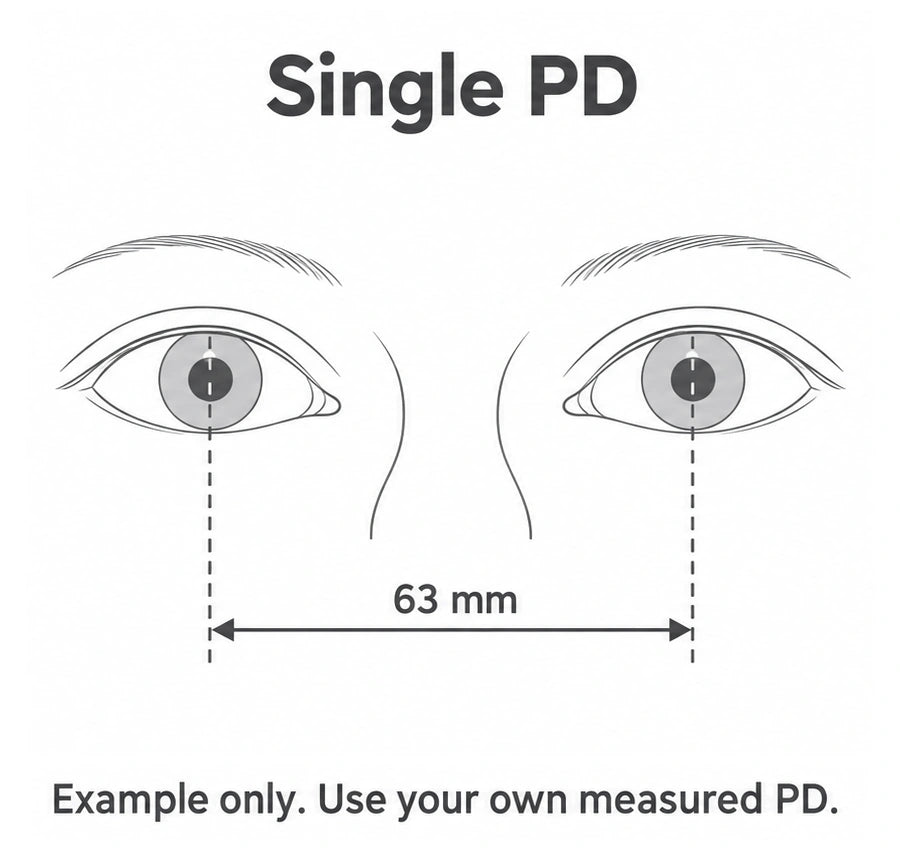
Single PD
One combined measurement across both eyes. Keep any distance or near label with the number.
Dual PD
Separate right and left measurements. Keep each value with its eye label; the two values do not have to match.
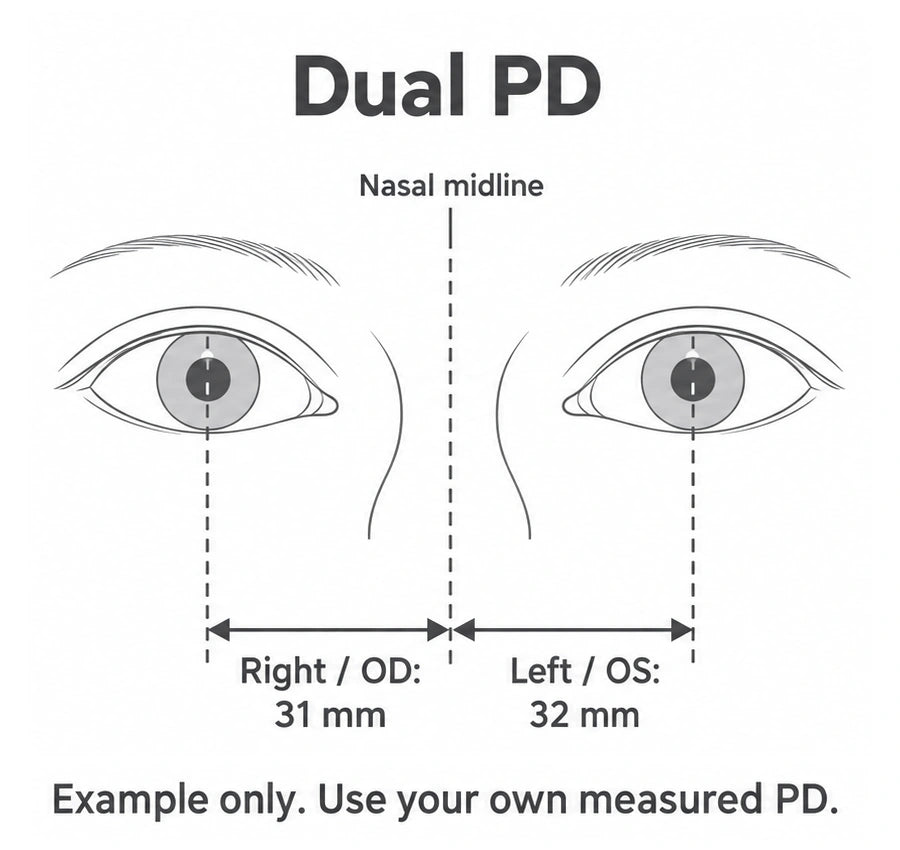
Do not divide a single PD to invent separate right and left measurements.
Find your measured PD
- Check your glasses prescription for a PD entry.
- If it is missing, ask your clinic or optician whether they have it on file.
- Confirm whether it is for distance or near work, and whether it is single or dual PD.
A home measurement check
A home check gives an estimate. A professional measurement is the best starting point for fitting your glasses.
- Use a ruler marked in millimeters. Stand about 18 inches (46 cm) from a mirror in good light.
- Hold the ruler just below your eyes, with the markings facing the mirror. Keep it level.
- Close your left eye. With your right eye, align the ruler's zero with the center of your right pupil.
- Keep your head and ruler still. Open your left eye and close your right.
- Read the millimeter mark aligned with the center of your left pupil. Write it down as a home estimate.
Repeat from the beginning to check consistency. If the ruler moves, start again. Repeated agreement does not prove accuracy, and inconsistent readings need professional checking. A printed ruler must be checked against a real ruler first.
This gives one combined measurement. If the labels or readings are unclear, ask your eye care professional before using them for an order.